



Abu Dhabi’s relentless push to reposition itself as the Middle East’s cultural capital warrants scrutiny, not applause. The Saadiyat Island constellation, including the Natural History Museum Abu Dhabi, teamLab Phenomena Abu Dhabi, the Zayed National Museum, and the perpetually delayed Guggenheim Abu Dhabi, now promises yet another colossal addition, “Dar Al Funoon.” One must ask: does the UAE genuinely aspire to cultural leadership, or is it simply accumulating branded architectural spectacles in a frantic bid for relevance?
A Capital of Culture, at a Price
For decades, Abu Dhabi languished in Dubai’s shadow, dismissed as the UAE’s wealthier but culturally barren counterpart. This flurry of institutional construction betrays a deep-seated anxiety to capture the attention and tourist footfall that its flashier neighbor commands so effortlessly. Rather than organically nurturing a cultural ecosystem, Abu Dhabi appears to be importing prestige wholesale, mistaking scale and marquee names for substance.
Unlike the region’s historically layered cultural capitals (Cairo, Damascus, Baghdad, and Istanbul), the UAE offers no ancient medinas and no organic artistic lineages. Undeterred, Abu Dhabi has bypassed its own thin cultural topsoil by purchasing global cultural credibility outright, signing starchitects and Western museum brands as if acquiring luxury franchises. The architecture critics have not been kind, and for good reason. These projects often read less as contextual cultural interventions than as vanity monuments dropped onto a tabula rasa, more concerned with iconic silhouettes on a skyline than with nurturing indigenous intellectual or artistic life.
The question is not whether Abu Dhabi is trying to introduce itself as a cultural capital; that ambition is embarrassingly transparent. The question is whether this top-down, spectacle-driven model can ever produce credible, self-sustaining cultural capital or merely an expensively furnished mirage of one.

Spectacle Without Soil
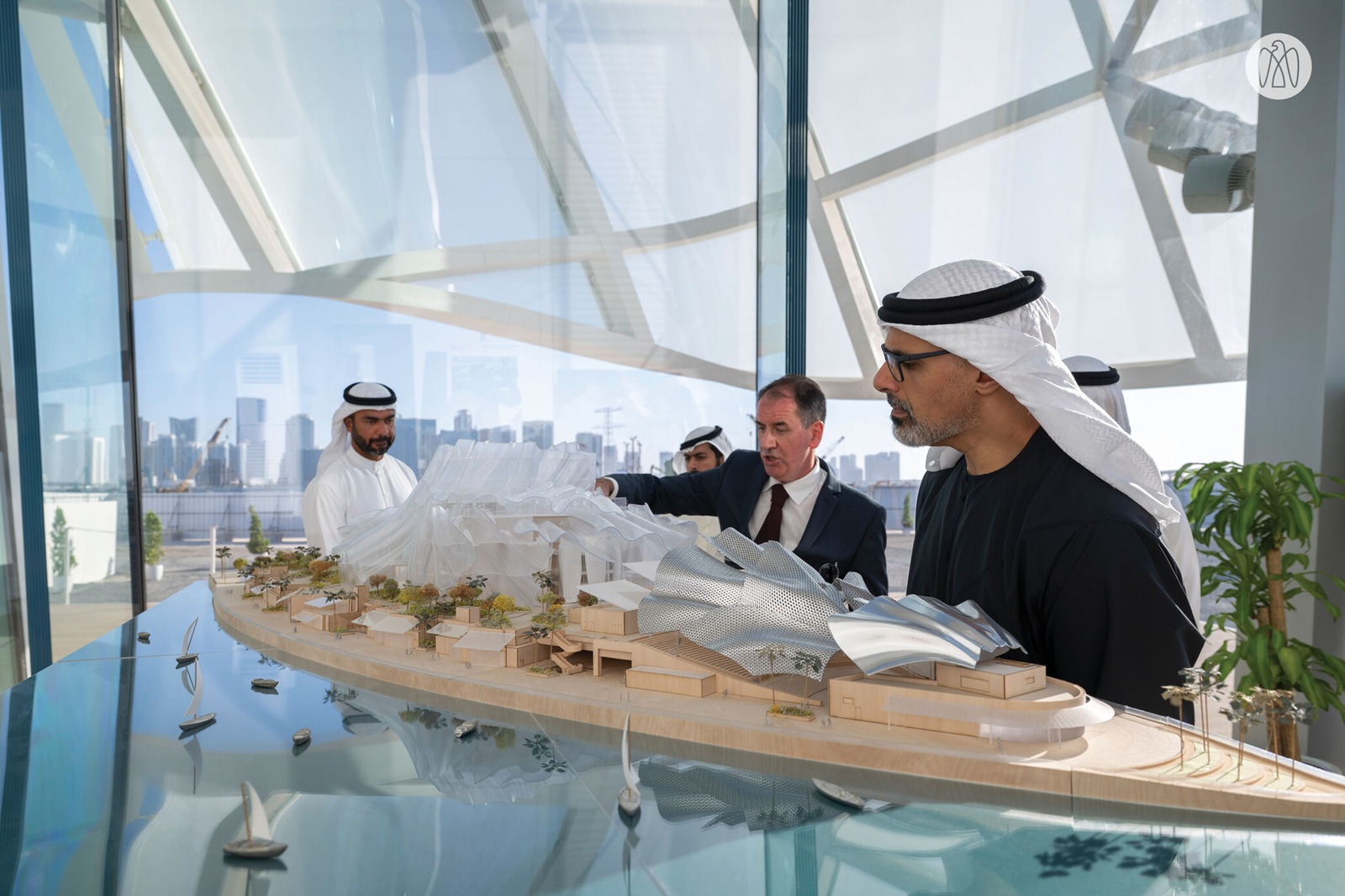
A very familiar fluid forms dancing around the Saadiyat cape, like Monroe’s skirt; is there any additional value behind it? The imagery is seductive, even cinematic: architectural forms billowing in a perpetual, frozen gust, evoking glamour, movement, and an effortless sensuality. But once the visual seduction subsides, one must ask what substance lies beneath the drapery. The skirt, after all, was famously a moment of spectacle, a flash of leg engineered for the cameras, revealing little of the woman beneath. So too with Saadiyat’s signature structures: their sinuous, windswept forms perform beautifully for the global media lens yet betray an uncomfortable emptiness when pressed for meaning.
What cultural value, precisely, does this borrowed formal language produce? The flowing fabric gesture, whether referencing falcon feathers, wind-sculpted dunes, or billowing silk, is now a regional cliché, a visual shorthand for Persian Gulf modernity that has been deployed from Doha to Dubai. In Abu Dhabi’s hands, it risks becoming not an expression of local identity but a generic, export-grade aesthetic of affluence, signifying nothing more specific than iconic.
The deeper issue is what this architectural theatrics conceals. Behind the undulating skirts and sculptural facades lies a transaction as old as empire: the importation of Western cultural templates onto a landscape rendered conveniently blank. The fluid forms suggest organic adaptation to place, yet the institutions they house (the Guggenheim, the Natural History Museum, and the Louvre’s Gulf outpost) arrive with predetermined logics, alien collections, and curatorial narratives forged continents away. The architecture dresses up this dislocation in the vocabulary of movement and grace, but the disjuncture remains: these are global franchises in bespoke haute couture, not indigenous cultural organs.
Value, then, depends entirely on one’s metric. If measured by Instagram tags, architectural awards, and the swooning prose of design magazines, the value is self-evident. If measured by the cultivation of local artistic practices, the generation of original scholarship, the nurturing of critical public discourse, or the genuine integration with the social and historical fabric of the region, the ledger remains conspicuously empty. The skirt may be exquisite, but one cannot help wondering whether there is anyone truly dancing inside it.

Bilbao Effect
To what extent is the so-called “Bilbao Effect” to blame for this epidemic of cultural mimicry? The original transaction bears all the hallmarks of a deal struck in a boardroom rather than a cultural vision born of a city’s soul: the Basque government, eager for a shortcut to global relevance, agreed to shoulder US$100 million in construction costs, inject a $50 million acquisitions fund, hand over a one-time $20 million fee to the Guggenheim foundation, and subsidize the museum’s annual budget to the tune of $12 million.
In return, the foundation graciously consented to manage the institution, rotate select pieces from its permanent collection through the Bilbao outpost, and organize temporary exhibitions. A franchise agreement, in essence, is dressed in the language of cultural partnership.
The Bilbao experiment was undeniably a success if one measures success in tourist footfall, hotel occupancy, and the regeneration of a post-industrial waterfront. Economically and in terms of sheer branding, it performed a minor miracle. But what the rest of the world eagerly copied was not Bilbao’s cultural awakening; it was the transactional blueprint.
Municipalities and petro-states alike saw a formula: invest heavily in an iconic architectural vessel, license a prestigious Western museum brand, and watch the tourists, the media attention, and the illusion of cultural maturity roll in. That the original Bilbao project was, at least, an organic response to a specific urban crisis (a decaying industrial city in a region with a distinct linguistic and cultural identity) was a nuance conveniently lost in translation.

What Abu Dhabi and its imitators imported was not Bilbao’s soul but its spreadsheet: the cost-benefit logic, the spectacle-first architecture, the institutional outsourcing. The risk, they calculated, was worth the reward: visibility, tourism revenue, cultural legitimacy by association. Yet the equation fundamentally misunderstands what made Bilbao resonant. Frank Gehry’s titanium curves did not merely attract cameras; they housed a museum that, however franchised, engaged with its Basque context. Saadiyat’s billowing skirts, by contrast, drape themselves over a void, offering architectural seduction without the institutional conviction to animate it. The Bilbao Effect, stripped of its contingencies, has become a global pathology: cities buying culture they have not cultivated, mistaking a museum for a movement.
The pathology runs deeper than mere imitation. What Abu Dhabi and its fellow travellers fundamentally fail to grasp is that the Bilbao Effect was never replicable as a pure transaction. The Basque Country possessed something the Persian Gulf emirates conspicuously lack: a thick weave of pre-existing cultural identity, a language older than Latin, a history of political struggle, and an artistic lineage that predated Gehry’s titanium by centuries. The Guggenheim Bilbao did not conjure culture from a vacuum; it amplified and internationalized a cultural confidence already present, however dormant.
Saadiyat Island, by contrast, emerges from a different trajectory entirely: one of sudden wealth, rapid modernization, and a demographic reality in which the native population constitutes a minority in its own capital. What does it mean to build a national museum when the nation’s own citizens are outnumbered ten to one by transient expatriates? What public are these institutions truly serving?

The financial model, too, deserves a colder eye. Bilbao’s investment was steep but finite, a calculated gamble by a regional government with democratic accountability and a constituency to answer to. Abu Dhabi’s cultural spending operates under no such constraints and no such scrutiny. The emirate’s willingness to write blank checks to starchitects and Western institutions reflects not a bold cultural vision but the absence of any mechanism requiring justification. When cost is no object, value becomes impossible to measure, and accountability evaporates. The result is an architectural theme park whose long-term sustainability depends entirely on the continued indulgence of autocratic patronage, not on the organic development of an arts ecosystem.
Even the Name?!
Then there is the matter of the name itself. “Dar Al Funoon” (the House of Arts) is not an invention but an appropriation, lifted directly from Iran’s Dar ul-Funun, the storied 19th-century polytechnic institute established in 1851 under Amir Kabir’s reformist vision. That Dar ul-Funun was a genuine crucible of modern education in the region, a place where Iranians encountered engineering, medicine, and the arts not as imported spectacle but as tools of national renewal. To strip the name of its historical weight and repurpose it as branding for yet another Persian Gulf megaproject is not homage; it is a quietly revealing act of cultural erasure.
Abu Dhabi, having no equivalent institution in its own history, simply borrows the signifier while discarding the signified, as if the mere invocation of a prestigious name could conjure the intellectual substance it represents. It is emblematic of the entire enterprise: a hollow gesture dressed in borrowed robes, mistaking appropriation for ambition.
Saadiat Afterlife
There is a final, uncomfortable question that haunts the entire enterprise: what happens when the spectacle fades? Bilbao endures because it has embedded itself within a living city, its museum woven into the urban fabric, its programming engaging local artists and audiences. Saadiyat remains an island in more than name: a curated enclave physically and psychologically removed from the rhythms of everyday Abu Dhabi life. Without roots in the local, without a public that claims these institutions as its own, the gleaming museums risk becoming what they most fear: exquisite mausoleums to an ambition that mistook branding for belonging.
Image credit: © Gehry Partners

