

Close Menu

    Subscribe to Updates

    Get the latest creative news from FooBar about art, design and business.

    What's Hot

    How the Loosdrecht Lakes Became the Netherlands’ Most Fascinating Residential Landscape

    July 31, 2026

    Tashkent’s Modernist Architecture Joins UNESCO World Heritage List

    July 31, 2026

    Architecture Is Growing Up with Gen Z

    July 30, 2026
    Facebook X (Twitter) Instagram
    Facebook X (Twitter) Instagram
    ParametricParametric
    Subscribe
    ParametricParametric
    Home»Articles»Can We Design Responsive Buildings Through Living Architecture?
    Articles

    Can We Design Responsive Buildings Through Living Architecture?

    Sümeyye OkumusBy Sümeyye OkumusApril 1, 202607 Mins Read0 Views
    Facebook Twitter Pinterest LinkedIn Tumblr WhatsApp Reddit Email
    Can We Design Responsive Buildings Through Living Architecture?
    Tree One - Living Architecture © Joonhwan Yoon
    Share
    Facebook Twitter LinkedIn Pinterest Email

    The construction and maintenance of buildings that shape our cities today are a significant source of greenhouse gases. Structures built with traditional materials, in addition to their initial environmental costs, often fail to adapt to change. These structures end up being dismantled in a costly and materially inefficient manner at the end of their lifespan. Energy and material inefficiency in construction has driven the search for a new generation of sustainable and environmentally conscious architecture.

    Can We Design Responsive Buildings Through Living Architecture?
    The Render Image of BIQ House © Arup

    In this context, “living architecture” has emerged, treating buildings as organisms that actively interact with, respond to, transform, and even produce within biological systems. This approach challenges harmful, human-centered design by promoting architecture that is more ecological, time-aware, and ethically responsible.

    Algae Building System

    One of the most interesting examples of this shift is the integration of microalgae into architectural systems that use light energy to convert water and CO₂ into organic compounds and oxygen. Due to their rapid growth rates and high content of nutrients and bioactive compounds, microalgae are utilized in various sectors, including cosmetics, pharmaceuticals, agriculture, food, bioenergy, and, more recently, architecture.

    Can We Design Responsive Buildings Through Living Architecture?
    © Arup

    Microalgae have become part of architectural systems by growing in diverse aquatic habitats and adapting to a wide range of environmental conditions, providing functions such as CO₂ absorption, oxygen production, shading, and climate regulation. With functions such as phytoremediation and biomass production, microalgae systems offer significant advantages when integrated into urban green buildings.

    Liquid Trees System: Photobioreactors

    Can We Design Responsive Buildings Through Living Architecture?
    Tree One © Joonhwan Yoon

    The role of trees in life is also crucial. By storing excess carbon dioxide in the atmosphere, trees combat climate change, produce oxygen, and capture particles to clean the air. However, trees need a large area and fertile soil to grow healthily. But some cities are not suitable for trees due to their infertile soil and limited space, making it impossible for long-lived trees to grow. Therefore, researchers are searching for systems like photobioreactors that can provide the benefits of trees without requiring actual trees.

    Can We Design Responsive Buildings Through Living Architecture?
    LIQUID-3 © LIQUID-3

    Photobioreactors are enclosed, illuminated systems containing large numbers of small photosynthetic organisms. These systems remove carbon dioxide from the surrounding environment while releasing oxygen into the air. As water passes through the reactors, algae filter pollutants such as nitrogen and phosphorus, aiding in wastewater treatment. Algae grown in photobioreactors can be produced efficiently and in a controlled manner without requiring large areas or fertile soil. Thus, they are seen as the future of trees in large cities where trees struggle to grow.

    Developed in Serbia, the photobioreactor known as LIQUID-3 utilizes a single-celled algal species native to the region. Capable of photosynthesizing year-round at both high and low temperatures, a 600-liter tank of these algae can cover an area roughly the size of a park bench and do the work of two 10-year-old trees or 200 m² of lawn. It can also be used as a streetlight or phone charging station thanks to its solar panel.

    Can We Design Responsive Buildings Through Living Architecture?
    LIQUID-3 © LIQUID-3

    Offering a rapid, short-term response to urgent air pollution and air quality challenges, LIQUID-3 begins purifying the air immediately after installation and requires significantly less maintenance than trees. The only maintenance required for these customizable photobioreactors is the removal of some of the growing algae every 6 weeks, and this excess can be used as fertilizer.

    Mycelium Architecture

    Can We Design Responsive Buildings Through Living Architecture?
    Mycelium as an Insulating Material © de Ecovative

    Fungi are found everywhere, from the air and water to our bodies and trees, and they play a key role as nature’s main recyclers. Typically growing well in shady and humid environments, fungi develop long, thread-like roots called mycelium beneath the surface. Mycelium is a fine white filament that grows quickly in all directions, forming a dense network that acts like a natural adhesive, binding the substrate into a solid block.

    Can We Design Responsive Buildings Through Living Architecture?
    The Growing Pavilion © Erik Melander.

    Due to its biomaterial potential, mycelium has gained increasing attention in the architectural field over the past few years. Edible, biodegradable, lightweight, and possessing high insulation performance, mycelium offers a promising step toward an architectural vision aligned with nature. Compared to conventional construction materials, mycelium-based materials naturally decompose at the end of their service life without leaving behind hazardous residues or pollutants. 

    A viable option in the search for ecologically friendly and sustainable building materials, mycelium can be molded to produce insulation panels, furniture, accessories, fabrics, and 

    How These Projects Define Living Architecture

    1. BIQ House

    Can We Design Responsive Buildings Through Living Architecture?
    BIQ House © Arup

    Located in Hamburg, Germany, the BIQ House apartment block boasts the world’s first biologically adaptable facade, generating heat and biomass through microalgae embedded in its facade. Introduced as part of an international building fair, the house was designed by the Austrian firm Splitterwerk in collaboration with Arup, the German firm Strategic Science Consult, and Colt International. 

    The building’s patented SolarLeaf façade system consists of 129 photobioreactors that give the structure its distinctive green appearance while providing high energy efficiency and multiple environmental benefits.

    Can We Design Responsive Buildings Through Living Architecture?
    © Arup

    The microalgae-based bioreactors are built into panels on the southeast and southwest facades of BIQ House and around its spacious loggias, where residents can easily observe them. Housed in slim glass panels containing algae sourced from a nearby branch of the Elbe River, the system creates a dynamic architectural surface characterized by constant movement and continuously changing shades of green.

    The 200 m² façade system is installed as a secondary structure on the southwest and southeast elevations. It is composed of clusters of three to five transparent glass containers, each 2.5 meters high and 0.7 meters wide, known as flat-panel photobioreactors (PBRs). These contain water and nutrients in which the microalgae circulate, absorb light and carbon, and produce biomass.

    Can We Design Responsive Buildings Through Living Architecture?
    © Arup

    In addition to generating heat and biomass, the system functions as a shading device, regulates daylight, and absorbs CO₂ emissions. Using sunlight, algae can grow through photosynthesis. Since they spend all their energy converting light into chemical energy, algae grow approximately 10 times faster than larger plants.

    2. Tree One

    Can We Design Responsive Buildings Through Living Architecture?
    Tree One © Joonhwan Yoon

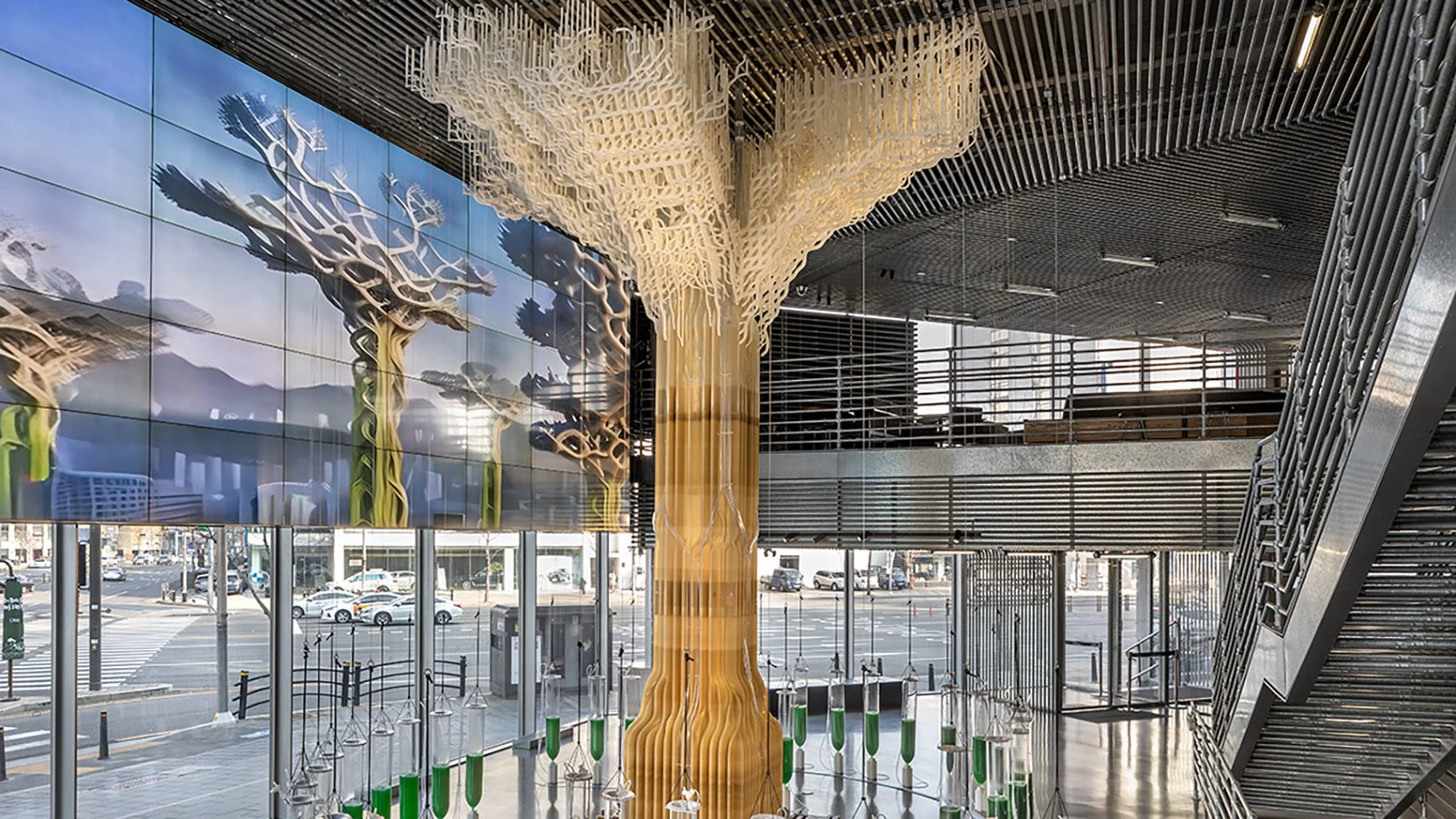
    Tree One is a ten-meter-high, photosynthetic architectural structure developed by ecoLogicStudio and exhibited in two exhibitions held at Hyundai’s studios in South Korea. The project transforms algae into a biodegradable polymer, which is then used to fabricate a tree-like structure capable of performing photosynthesis. 

    Can We Design Responsive Buildings Through Living Architecture?
    © Joonhwan Yoon

    Produced with a 3D printer, this tree has the same capturing potential as 12 mature trees, releasing oxygen into the atmosphere while re-metabolizing carbon molecules and storing them in its trunk and canopy. The canopy, produced with high-resolution 3D printing, traps the captured CO₂ molecules in a decorative structure that acts as a carbon sink that shades an area of ​​over 25 m².

    Can We Design Responsive Buildings Through Living Architecture?
    © Joonhwan Yoon

    Tree One incorporates two algae-based components. The 3D-printed trunk is made from a biopolymer formulated from biomass derived from harvested microalgae. A series of photobioreactors containing live cyanidium microalgae cultures is integrated into the trunk and the base of the installation. 

    Inspired by the air-purifying power of algae, Tree One is designed using 40 photobioreactors containing 500 liters of algae culture that draw carbon dioxide from the air and release oxygen as they grow. This allows it to actively photosynthesize.

    3. The Growing Pavilion

    Can We Design Responsive Buildings Through Living Architecture?
    The Growing Pavilion © Oscar Vinck

    Designed by Biobased Creations in collaboration with Dutch Design Week and the Floriade Expo in 2019, The Growing Pavilion was constructed in Almere, the Netherlands. Showcasing bio-based materials and sustainable construction practices, the structure is a prominent example of mycelium architecture. The structure is supported by a timber frame, while its exterior panels and roof were grown from fungi, with the mycelium in their root systems providing structural strength.

    Can We Design Responsive Buildings Through Living Architecture?
    The Growing Pavilion © Oscar Vinck

    As a result, the pavilion achieves excellent thermal insulation and acoustic performance, demonstrating how biologically grown materials can function as high-performance architectural components.

    The Growing Pavilion © Erik Melander.
    The Growing Pavilion © Oscar Vinck
    The Growing Pavilion © Oscar Vinck
    Mycelium as an Insulating Material © de Ecovative
    © Joonhwan Yoon
    Tree One - Living Architecture © Joonhwan Yoon
    © Joonhwan Yoon
    Tree One © Joonhwan Yoon
    Tree One © Joonhwan Yoon
    LIQUID-3 © LIQUID-3
    LIQUID-3 © LIQUID-3
    The Render Image of BIQ House © Arup
    © Arup
    BIQ House © Arup
    © Arup
    © Arup
    Algae Building System BIQ House LIQUID-3 Living Architecture Mycelium Responsive Buildings Tree One
    Share. Facebook Twitter Pinterest LinkedIn Tumblr Email
    Sümeyye Okumus

    Sümeyye is an architect who combines her passion for architecture with her love of reading, research, and writing.

    Related Posts

    Architecture Is Growing Up with Gen Z

    July 30, 2026

    Beyond the Architect: Rethinking Power and Hierarchy in Contemporary Construction Projects

    July 27, 2026

    Why Clearing the Room First Changes Every Renovation Decision You Make

    July 27, 2026
    Add A Comment
    Leave A Reply Cancel Reply

    Demo
    Top Posts

    FIFA World Cup 2030 Stadium Guide

    July 26, 202612 Views

    Harvard Unveils Shape-Shifting Knitted Fabric with Built-In Sensors

    July 26, 202611 Views

    How the Loosdrecht Lakes Became the Netherlands’ Most Fascinating Residential Landscape

    July 31, 20263 Views

    Why Clearing the Room First Changes Every Renovation Decision You Make

    July 27, 20263 Views
    Don't Miss

    How the Loosdrecht Lakes Became the Netherlands’ Most Fascinating Residential Landscape

    By Isha ChaudharyJuly 31, 2026

    What appears to be an AI-generated landscape has become one of the internet’s latest architectural…

    Tashkent’s Modernist Architecture Joins UNESCO World Heritage List

    July 31, 2026

    Architecture Is Growing Up with Gen Z

    July 30, 2026

    Populous to Shape Frankfurt’s Next Major Sports and Entertainment Arena

    July 30, 2026

    Subscribe to Updates

    Get the latest creative news from SmartMag about art & design.

    Demo

    Recent Posts

    • How the Loosdrecht Lakes Became the Netherlands’ Most Fascinating Residential Landscape
    • Tashkent’s Modernist Architecture Joins UNESCO World Heritage List
    • Architecture Is Growing Up with Gen Z
    • Populous to Shape Frankfurt’s Next Major Sports and Entertainment Arena
    • Chile’s 2026 National Architecture Prize Awarded to Pritzker Laureates Alejandro Aravena and Smiljan Radić

    Recent Comments

    No comments to show.
    About Us
    About Us

    Your source for the lifestyle news. This demo is crafted specifically to exhibit the use of the theme as a lifestyle site. Visit our main page for more demos.

    We're accepting new partnerships right now.

    Email Us: [email protected]
    Contact: +1-320-0123-451

    Our Picks

    How the Loosdrecht Lakes Became the Netherlands’ Most Fascinating Residential Landscape

    July 31, 2026

    Tashkent’s Modernist Architecture Joins UNESCO World Heritage List

    July 31, 2026

    Architecture Is Growing Up with Gen Z

    July 30, 2026
    Most Popular

    FIFA World Cup 2030 Stadium Guide

    July 26, 202612 Views

    Harvard Unveils Shape-Shifting Knitted Fabric with Built-In Sensors

    July 26, 202611 Views

    How the Loosdrecht Lakes Became the Netherlands’ Most Fascinating Residential Landscape

    July 31, 20263 Views

    Archives

    • July 2026
    • June 2026
    • May 2026
    • April 2026
    • March 2026
    • February 2026
    • January 2026
    • December 2025
    • November 2025
    • October 2025
    • September 2025
    • August 2025
    • July 2025
    • June 2025
    • May 2025
    • April 2025
    • March 2025
    • February 2025
    • January 2025
    • December 2024
    • November 2024
    • October 2024
    • September 2024
    • August 2024
    • July 2024
    • June 2024
    • May 2024
    • April 2024
    • March 2024
    • February 2024
    • January 2024
    • December 2023
    • November 2023
    • October 2023
    • September 2023
    • August 2023
    • July 2023
    • June 2023
    • May 2023
    • April 2023
    • March 2023
    • February 2023
    • January 2023
    • December 2022
    • November 2022
    • October 2022
    • September 2022
    • August 2022
    • July 2022
    • June 2022
    • May 2022
    • April 2022
    • March 2022
    • February 2022
    • January 2022
    • December 2021
    • November 2021
    • October 2021
    • September 2021
    • August 2021
    • July 2021
    • June 2021
    • May 2021
    • April 2021
    • March 2021
    • February 2021
    • January 2021
    • December 2020
    • November 2020
    • October 2020
    • September 2020
    • August 2020
    • July 2020
    • June 2020
    • May 2020
    • April 2020
    • March 2020
    • February 2020
    • January 2020
    • November 2019
    • October 2019
    • September 2019
    • August 2019
    • July 2019
    • June 2019
    • May 2019
    • April 2019
    • March 2019
    • February 2019
    • January 2019
    • December 2018
    • November 2018
    • October 2018
    • September 2018
    • August 2018

    Categories

    • 3D Printing
    • Ads
    • Archipreneurs
    • Architects
    • Architecture
    • Architecture & Design
    • Architecture News
    • Articles
    • Artificial Intelligence
    • BIM / AEC
    • Books
    • Case Study
    • CDNext
    • CDNEXT Recordings
    • City Guide
    • Competitions
    • Design
    • Digital Art
    • Digital Members
    • Events
    • Fashion
    • Geography
    • Installation
    • Interior
    • Interviews
    • Jobs
    • landscape
    • Landscape Architecture
    • Landscape Design
    • memorial
    • Metaverse
    • Opinions
    • PA Quotes
    • PA Talks
    • PAACADEMY
    • Pavilion
    • podcasts
    • Products
    • Projects
    • Robotics
    • Space Architecture
    • Studio Recordings
    • Studio Workshops
    • Sustainability
    • Technology
    • Tools
    • Urbanism
    • Videos
    • Workshops
    Facebook X (Twitter) Instagram Pinterest Dribbble
    © 2026 ThemeSphere. Designed by ThemeSphere.

    Type above and press Enter to search. Press Esc to cancel.