



Japanese animation carried its popularity from the beginning with a wide range of topics and exploration of different visualizations. The uniqueness of each film creates a strong influence. This uniqueness does not only come from the characters and the story, but also the design of the environments, architecture, and landscape relations. Various names have been known for these architectural and visual representations, along with the characters and stories.
These names can be counted as Katsuhiro Otomo (Akira), Satoshi Kon (Paprika), Makoto Shinkai (Your Name.), and Tsutomu Nihei (Blame!), among others. The most renowned one by Western audiences is Hayao Miyazaki with Studio Ghibli. He had a great influence on the popularity of Japanese animation. His early works are still being watched by multiple generations. His portrayal of places and characters has always been a unique and attractive point of his animations.

Hayao Miyazaki was known for his vision of the modern world, which was increasingly affected by advanced technology and a detachment from the natural environment. His focused approach to human effect with modernization in his movies highlighted this detachment and aimed to present concerns on certain social and natural issues. This article aims to highlight his influence in animation and list his famous films in which modernization and architecture play a unique role.

“I saw how people have polluted the sea and came back home angry. I don’t think we’re born with a natural tendency to protect the environment. I think it’s something we learn if we’re educated and brought up to have the manners to care for the world. At some stage in our lives, the greed factor became stronger, and that has led us to the horrible situation we’re in now. A change is necessary, and I believe my films convey that.” Hayao Miyazaki
Hayao Miyazaki was born in 1941, Tokyo. His first active interest in animation was during his high school years. He worked in detail on how people move and what motivates them to move. One of the key features of Miyazaki’s animations is that his characters move with spiritual urgency rather than mechanical accuracy. He has been an inspiration for multiple generations by narrating the evolution of Japanese society through animation under his company, Studio Ghibli.
Studio Ghibli, one of the most famous animation companies, was founded in 1985 by Hayao Miyazaki, Toshio Suzuki, Isao Takahata, and Yasuyoshi Tokuma after the great success of Miyazaki’s Nausicaä of the Valley of the Wind.
Most of the films produced by Studio Ghibli were written and directed by Miyazaki. Studio Ghibli is famous for the films that act as a narrative for the themes of pacifism, ecology, Japanese mythology, and urban legends. Miyazaki puts humans in the center of stories. However, nature and human-made spaces are always together to tell the story. These elements in his movies are always arranged to represent good or evil, according to the story. The balance created within these elements and representations encourages the experience of the spirit of a place.

Miyazaki’s career began in the early 1960s, the time of reinvention in Japan. The Metabolist Movement was one of the leading influences during that time. This movement was affecting the country into a modern and avant-garde era. Changing architectural structures and cities affected the cultural shift. This socio-architectural context forms a solid foundation for Miyazaki’s “architectural” production and is addressed in various ways in his various works.
Miyazaki’s architectural vision is highly influenced by his travels around the world and his desire to explore technology and destruction. His films highlight his thoughts on nature and humans and their unification. He puts them not as separate entities but as a mutual unicum. The nature represented in Miyazaki’s worlds has a life of its own, and if you disturb it, it reacts mercilessly.
Hayao Miyazaki’s films are still popular and serve as an icon today. The detailed works of story, characters, architecture, landscape, and visualizations of his films prove themselves as a cult in cinema. Here is a part for a closer look at Hayao Miyazaki’s five famous films:
Nausicaä of the Valley of The Wind (1984)
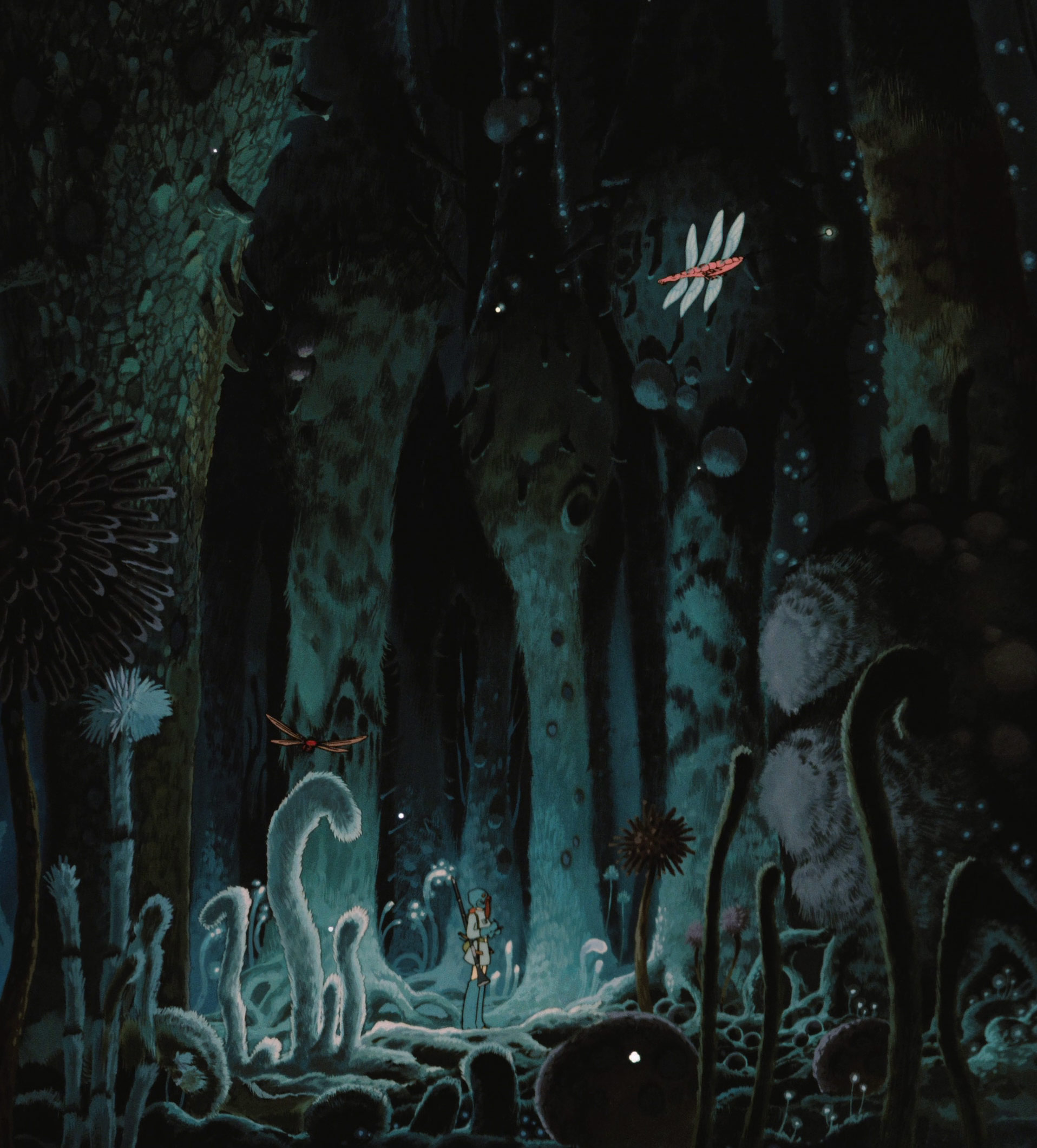
Nausicaä of the Valley of the Wind is a post-apocalyptic Japanese animation based on the manga series written and illustrated by Hayao Miyazaki. The story is inspired by Miyazaki’s investigation of erosion between nature and the human soul. It is a confrontation of nature’s awakening and punishment of humans after an environmental catastrophe. The film starts with a post-war civilization, ‘Seven Days of Fire,’ where the earth is virtually destroyed and swallowed by a poisoned sea.
Princess of the Valley, Nausicaa, is shielded from the Rotten One’s poison by the High Wind, which comes in from the sea. The film continues with the war between the two kingdoms of Pejite and Tolmechia that is caused by the threat of the Rotten Sea and the Toxic Forest, which contains dangerous insects and poisonous spores. With the desire to gain the ultimate weapon, the last Titan Soldier, the peaceful Valley of the Wind will turn into a place that will host this battle.
Starting with the depiction of the location in the film, Miyazaki tells the story with distinct realism. The Metabolist influence emerged through the revival of Titan Soldier, which can be counted as the representation of advanced technology. The city of Pejite was a house for craftsmen who lived in harmony with nature. However, human selfishness about power will make the landscape surrounded by wild green and make buildings and trees covered in spores, and things will crumble with the eerie sound of the wind.
The feeling of loneliness in this landscape creates a frightening experience. The utopian vision of Miyazaki that highlights the importance of mutual respect between humans and nature is presented with Nausicaa’s secret garden in the movie. The greenhouse is isolated and uncontaminated from the outside world, and she grows various plants to keep the ecosystem alive.
In the Nausicaä of the Valley of the Wind, there is a representation of the Taoist way of life. Agriculture and architecture are harmoniously intertwined with nature alongside the disturbing realities of war. Within this unending cycle of destruction and reconstruction, humans become strangers to nature, thrust into environments of industrialization that strip away their inherent dignity.
Laputa: Castle in the Sky (1986)

Laputa: Castle in the Sky is a Japanese animation produced by Studio Ghibli. It was written and directed by Hayao Miyazaki. The story starts with Sheeta on an airship that gets attacked by pirates. After she attempts to escape, she falls out of the sky but is saved by the mysterious blue necklace that allows her to gently float down to earth.
The necklace creates one of the plots of the movie in which the group of pirates and agents track Sheeta to steal her necklace. She meets with an orphan boy named Pazu who takes her into his local mining town. Pazu tells her about a mysterious floating island, Laputa, which is visible in a picture taken by his father, where Sheeta happens to be the royal descent of the long-forgotten kingdom.
In Laputa, Miyazaki creates a physical detachment of the castle from the ground level, as if to mark human’s utopia towards a society integrated with nature. Focusing on the beauty inherent in the relationship between humans and nature, the film represents a unique approach to architecture. The living spaces in the movie are shaped by local materials and traditions.
The simplicity and warmth are a leading depiction that evokes serenity and an appreciation for the surroundings. In this movie, it is highlighting the possibility of a peaceful and simple life rather than the Metabolist Movement’s emphasis on the rapid optimization of space. The modest characterization and unassuming spaces create a life that is rooted in tradition and is people-oriented.
My Neighbor Totoro (1988)

My Neighbor Totoro is a Japanese animation written and directed by Hayao Miyazaki. The movie is one of the most known works of Miyazaki and the character in the movie, Totoro, has become the mascot of Studio Ghibli. As in almost every Miyazaki film, My Neighbor Totoro highlights the human-nature relationship through the story. The film tells the story of a father and his two children.
To pursue a pure and spontaneous life, the small family moves to the countryside and immerse themselves in nature. This start of the story highlights Miyazaki’s message, the duty of humans to maintain a peaceful role towards nature. While children Mei and Tatsuki continue their lives intertwined with the forest, Mei soon begins to see forest spirits. Here, they meet Totoro, and the film progresses with the lives of the two sisters, their mother’s illness, daily events, Totoro, and various forest spirits.
While Totoro becomes the most famous feature of the film, the architectural features are also one of the inspirations for the real world. The relationship between village life and nature appears dominantly in the film. The village house that is engraved in memories is the house where this little family lived. The traditional Japanese house appearance of the building takes attention, and the life in this house is depicted through the film. We can see the basic features of a house during the movie, such as the father’s study room.
The house surrounded by the forest also highlights the closeness to nature, and, as in modern life, the film also approaches this relationship with honesty. Both the good sides and bad sides of this close living are shown, such as the storm coming with threats of destruction, vegetables coming with bugs, and the dark nights. With these realities and the forest spirits, Miyazaki shows modern humans the fine lines to avoid disturbing nature.

There are various examples where popular animations, films, or thoughts can affect real-life productions. My Neighbor Totoro has also influenced various architectural productions over time. And one of these productions can be the real-world replica of the main house in the film. The real-life scale Totoro House was constructed in Nagakute city with all the details in the film, including the furniture, and possessions that are related to characters and the story. This museum-like building is open to visitors and attracts many Miyazaki fans. The Totoro house also has an influence on many modern buildings with its approach to nature relations. The same named project by CplusC Architectural Workshop can be given as an example of these modern buildings.
Princess Mononoke (1997)

Princess Mononoke is one of the most known animations written and directed by Hayao Miyazaki. The film paved the way for international recognition of Studio Ghibli. It is one of the distinctive depictions of Miyazaki’s approach to nature-human relations and capitalism. Miyazaki does not tend to define right or wrong, rather he aims to highlight the changing relation with his stories. The film also shows Miyazaki’s inspiration from Japanese history and traditions.
Princess Mononoke’s main character is an Emishi prince, which is an ancient native ethnic group in Japan who worshiped the forest and spirits. The prince’s name is Ashitaka and the story begins with his infection by a demon while protecting his village. With the aim of discovering what caused the boar god’s transformation into a demon, he leaves his village, and through his journey, he finds himself in the Iron Town. Iron Town is an industrially growing town run by Lady Eboshi. He finds out about the war between the human settlement led by Lady Eboshi and the animal gods of the forest led by Princess Mononoke.
The story of the film Princess Mononoke continues in the Iron Town, Tataraba. The camps of iron forgers in the mountains are depicted in an eerie sense. Miyazaki highlights the rise of modern humans with the desire to sacrifice anything to get iron. In this case, they are sacrificing mountains, which are sacred in Japanese religion.
Through the story Ashitaka realizes that there will be no winner in the war between Lady Eboshi and Princess Mononoke, rather there will be destructive harm on both humans and nature. From the architectural point of view, while the film does not necessarily contain or highlight specific buildings, the message given by destroying nature to obtain natural resources for human benefits holds significant importance today. The captivating view of capitalism in the film offers valuable lessons for developing urbanism, too.
Spirited Away (2001)

Last but not least, the most famous and known masterpiece of Hayao Miyazaki, Spirited Away, is a movie that carries multiple messages for multiple generations. The film depicts various themes, identity, greed and isolation, and loss of past throughout the architectural details, characters, and storyline. The story highlights Miyazaki’s approach to the notion of learning to live with a pure heart and mind. The main character, Chihiro, described as a spoiled girl at first, goes through a spiritual transformation during the film. Her transformation journey starts in the now iconic bathhouse of the witch Yu-Baaba. She goes through tests and tribulations while obtaining a pure heart that allows her to return home.
The film contains detailed works of architecture, history, and visualizations. Different architectural elements can be seen throughout the film, such as the train station, the route through the spirit world, the village with commercial use, the main bridge, and the bathhouse. Although the story takes place in a supernatural city, the animation of this city was mostly based on Edo-Tokyo Park, located near Studio Ghibli. The park acts as an open exhibition of traditional buildings in Tokyo. These buildings are relocated or rebuilt to showcase and preserve the various architectural styles throughout history that could have been torn down by war, destruction, or natural disasters.

Each building seen in the film has been created in detail and most of them were inspired by real buildings. One of the most significant buildings in the film is the bathhouse, which resembles the public bathhouse in Edo-Tokyo Park. The interior of the bathhouse in the film is inspired by one of the seven rooms at Hyakudan Kaidan, which is now a hotel in Shimomeguro, Tokyo. Inspired by real buildings, the film contains various details from traditional Japanese architecture, such as lush carved wooden pillars and lavish ornate ceilings. This detailed work of architectural representation plays an integral role in the film and puts the audience in a position to locate themselves spatially in the spiritual world.
